
Children’s books sit in a strange and interesting space because they are never just one kind of storytelling.
They are always doing two things at once. Words are telling you what is happening while images are showing you how it feels. Most of the time, those two things are not even saying it in the same way.
Words are structured. They move in order. One thing happens after another and everything is explained in a clear line.
Images do not work like that. They hit you all at once. You see emotion and meaning in a single moment without needing anything to be spelled out.
That difference is where the real depth of picture books comes from.
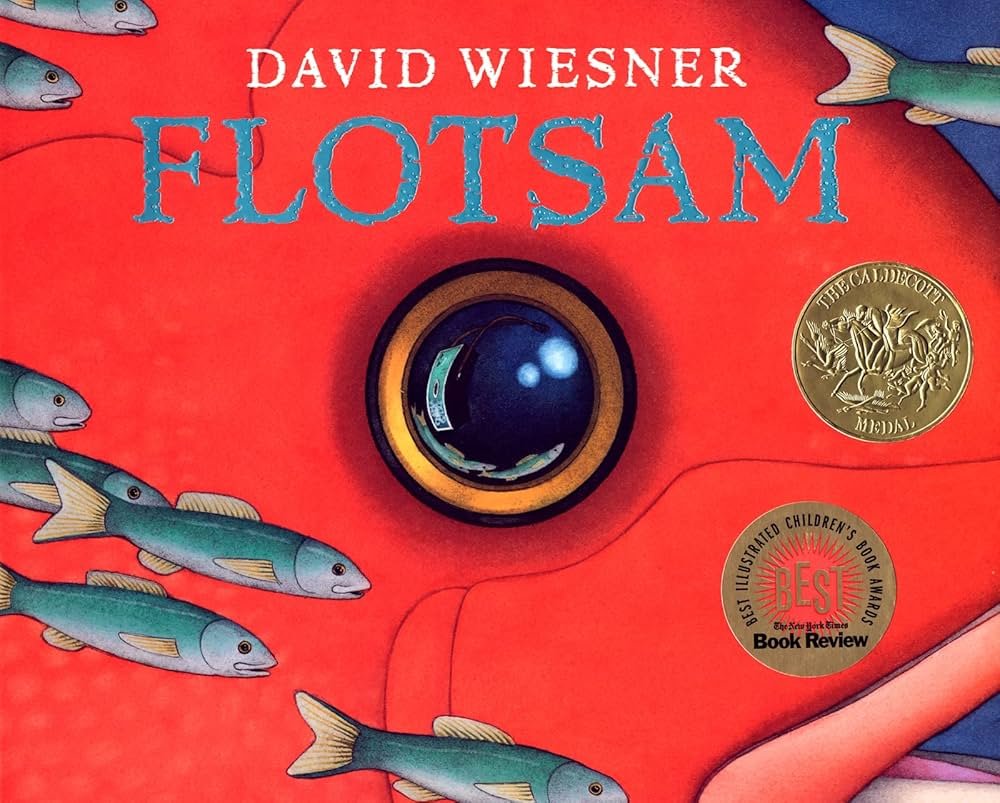
A book like Flotsam by David Wiesner shows this perfectly because there are no words at all. The entire story is carried through images.
A strange underwater camera washes up on a beach and what follows is a chain of photographs that reveal different worlds and moments connected through time. Nothing is explained but everything is understood.
You piece it together through what you see, not what you are told.
That is what makes visual storytelling powerful. It trusts the reader to figure things out.
In most children’s books though, words and images work together in a more complicated way. Sometimes they match, but often they do not.
The text might say something simple while the illustration shows something more emotional underneath it.
Images also control how a story moves. A large open spread slows everything down. It forces you to sit in a moment longer. Smaller or more frequent images speed things up and create a sense of motion.
That pacing is not accidental. It is part of how illustrators shape emotion across the book.
What ends up staying with you is usually not just the words or just the images. It is the combination of both and sometimes the contrast between them.
The strongest children’s books are the ones where neither part is fully explaining the story on its own. They are working together in a way that leaves space for interpretation.